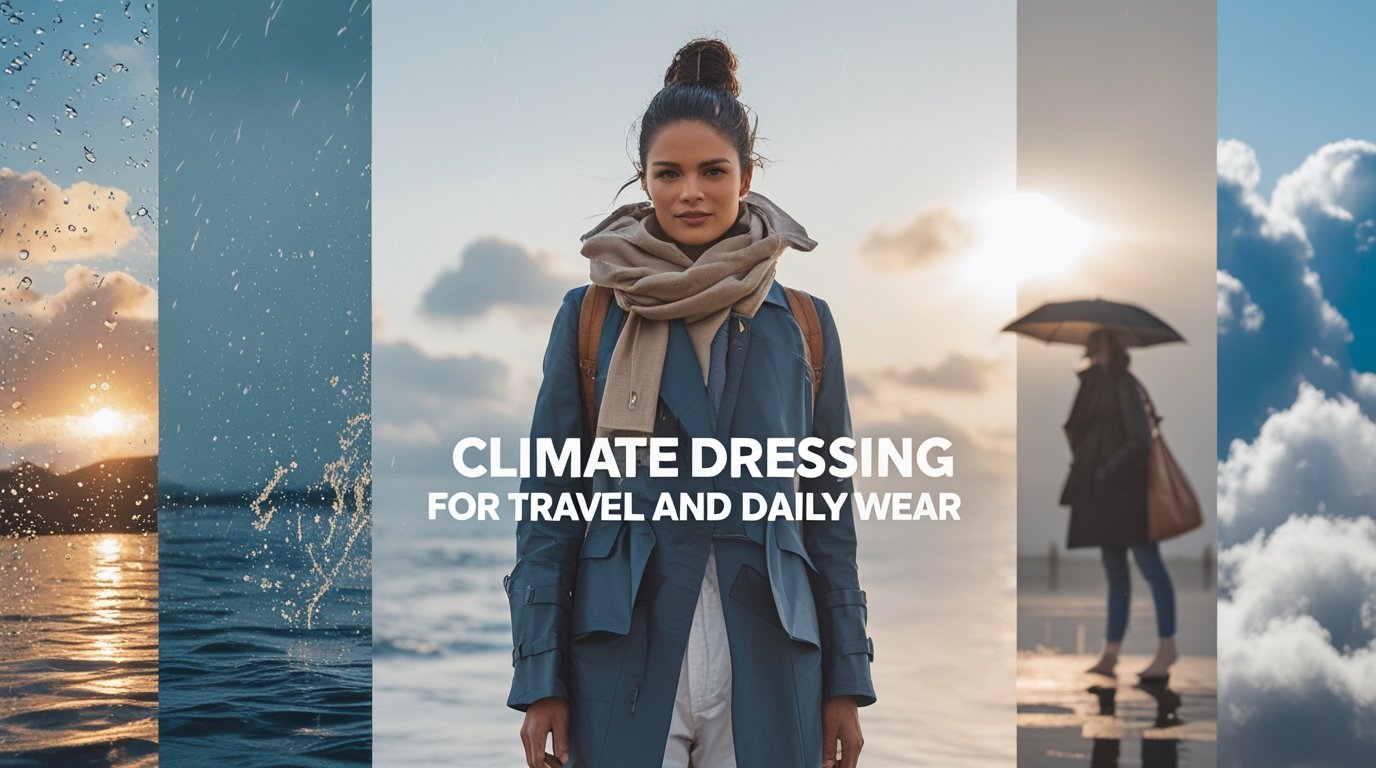
I learned to dress for the climate the hard way. I once showed up in Scotland in August with a suitcase full of linen and cotton, envisioning crisp, sunny hikes. I spent a week damp, cold, and miserable, wearing every layer I owned at once, looking like a panicked onion. Conversely, I’ve wilted in a humid Tokyo spring in a synthetic blazer that turned into a personal sauna. I was treating climate as a backdrop, not the lead actor. Climate dressing isn’t about packing for “cold” or “hot.” It’s about engaging in a material science conversation with the atmosphere. It’s the difference between enduring the weather and moving through it with ease, whether you’re commuting in Chicago or trekking in Patagonia.
Fabric as Your First Filter:
Your first decision is never color or cut; it’s fiber. Getting this wrong makes everything else irrelevant.
For Hot & Humid (Southeast Asia, Gulf Coast summers), your enemy is moisture trapped against your skin. Cotton, while natural, is a trap. It absorbs sweat but dries slowly, leaving you in a cold, soggy shirt. My salvation was merino wool. Not your grandpa’s itchy sweater. Fine-gauge merino is miraculously light, breathable, and possesses natural odor resistance. It wicks moisture away from your skin and dries relatively quickly. Linen is the other champion, its loose weave allows for maximum airflow. For synthetics, look for moisture-wicking polyester or nylon labeled for performance, but ensure they are designed for breathability to avoid that “plastic bag” feeling.
For Cold & Damp (UK, Pacific Northwest), the enemy is wetness that saps heat. Cotton is lethal here, it holds moisture and loses all insulating power. This is where technical fabrics shine. A base layer of merino wool again is ideal, as it retains warmth even when damp. The mid-layer should be fleece or a puffy insulated layer filled with PrimaLoft (a synthetic insulation that retains heat when wet, unlike down). The outer layer must be a windproof and waterproof (not just water-resistant) shell with sealed seams (look for a high HH rating, Hydrostatic Head).
For Dry Heat (Desert climates, Mediterranean summer), the goal is sun protection and breathability. Linen, lightweight cotton, and rayon work well. A loose weave and light colors that reflect sunlight are key. Here, covering up with a long-sleeve, loose linen shirt is often cooler than a sun-exposed t-shirt.
The Layer Matrix: Systems, Not Just Items:
Piling on clothes is not layering. Strategic layering is about creating a modular system of microclimates you can adjust without overhauling your outfit.
My universal three-part system is:
- The Base Layer: Manages moisture. This is your skin-contact layer. In heat, it’s a wicking tee or tank. In cold, it’s fitted merino wool.
- The Insulation Layer: Traps warmth. This is your adjustable core. A zip-neck merino sweater, a lightweight fleece gilet (vest), or a packable puffer. Its job is to be easily added or removed.
- The Shell Layer: Shields from elements. A windbreaker, a rain jacket, or a soft-shell jacket. This is your final barrier.
The magic is in the interplay. On a drizzly, 50-degree (10°C) day in Amsterdam, I might wear a merino base, a cotton button-down (light insulation), and my waterproof shell. If the rain stops and the sun peeks out, I remove the shell. If I go into a museum, I might remove the button-down. I’m constantly fine-tuning my comfort with 30-second adjustments.
Travel Pragmatism: The Capsule Built for Flux:
This philosophy makes packing transformative. I no longer pack for “a trip.” I pack for a climate profile.
For a variable climate trip (like spring in the mountains), I deploy my full three-layer system, but in its most versatile form:
- Base: Two merino wool t-shirts. They can be base layers or stand-alone tops.
- Insulation: One fine-knit merino sweater (warm but packs small) and one packable, ultralight down or PrimaLoft jacket.
- Shell: One lightweight, waterproof jacket that stuffs into its own pocket.
- Bottoms: One pair of technical trousers (like Lululemon ABC or Outlier Slim Dungarees) that are stretchy, stain-resistant, and look presentable, and one pair of shorts or jeans, depending on the likely low temp.
- Footwear: One pair of versatile, waterproof sneakers (like Allbirds Mizzles or Vessi’s).
Every item must play multiple roles across the layer system. The merino tee is a base layer, a sleep shirt, and a casual top. The packable puffer is evening insulation and a pillow on the plane.
Daily Wear Integration: The Unseen Tech:
The biggest shift was applying this to my daily, non-travel life. I purged my closet of items that failed the climate test.
I live in a place with distinct seasons. My winter wardrobe now heavily features merino wool blends for sweaters and socks. I invested in a few quality shell jackets, a long, city-appropriate raincoat for commutes, and a shorter, technical one for active weekends. I stopped buying cheap, non-breathable “fashion” raincoats that left me sweaty and damp on the inside.
For summer, I embraced linen and lightweight merino as my workhorse fabrics. I have a few unstructured, unlined “breathable blazers” in technical blends for meetings where I need to look sharp but not melt. I learned that fit is a climate tool, looser fits in heat promote airflow; tailored fits in cold prevent wind from rushing in.
The Mindset: Dressing as Dialogue:
Ultimately, climate dressing changed my relationship with my clothes. I see them less as aesthetic statements and more as functional tools. I read garment tags with the focus of an engineer. I seek out brands that prioritize technical natural fibers or intelligent synthetics.
The result is a profound sense of preparedness and comfort. I’m no longer at the mercy of a surprise downpour or a chilly restaurant. I’m equipped for the day’s dialogue with the elements. It removes a low-grade stress I didn’t even know I had. Whether I’m walking to the grocery store or navigating a foreign city, I’m no longer just dressed; I’m appropriately equipped.
The Conclusion:
Climate dressing is the ultimate marriage of practicality and style. It asks you to respect the environment you’re stepping into and arm yourself accordingly with intelligent fabrics and smart layers. It’s not about buying a new wardrobe; it’s about changing how you see the one you have. When your clothes work with the weather, you gain an effortless confidence, leaving you free to focus on everything else the day has to offer.
FAQs:
1. What is the single most versatile fabric for variable climates?
Merino wool, for its natural temperature regulation, moisture-wicking, and odor resistance in both warm and cool conditions.
2. Can climate dressing still be stylish?
Absolutely, as many technical and performance-focused brands now offer designs with clean, minimalist aesthetics suitable for urban environments.
3. Is this approach expensive?
It can be an investment upfront in key pieces (like a merino sweater or a quality shell), but these items last longer and replace multiple inferior ones.
4. What’s the biggest mistake people make?
Choosing materials based on style alone (e.g., a cotton jacket for rain) rather than the functional demands of the climate.
5. How do I start applying this to my existing wardrobe?
Audit your clothes by fabric tag, identifying and phasing out items like 100% cotton for cold/wet scenarios, and start with one key multi-climate piece like a merino layer.
6. Does this mean I need a separate “travel” wardrobe?
Not at all; a climate-conscious daily wardrobe is your ideal travel wardrobe, built on versatile, layered principles.